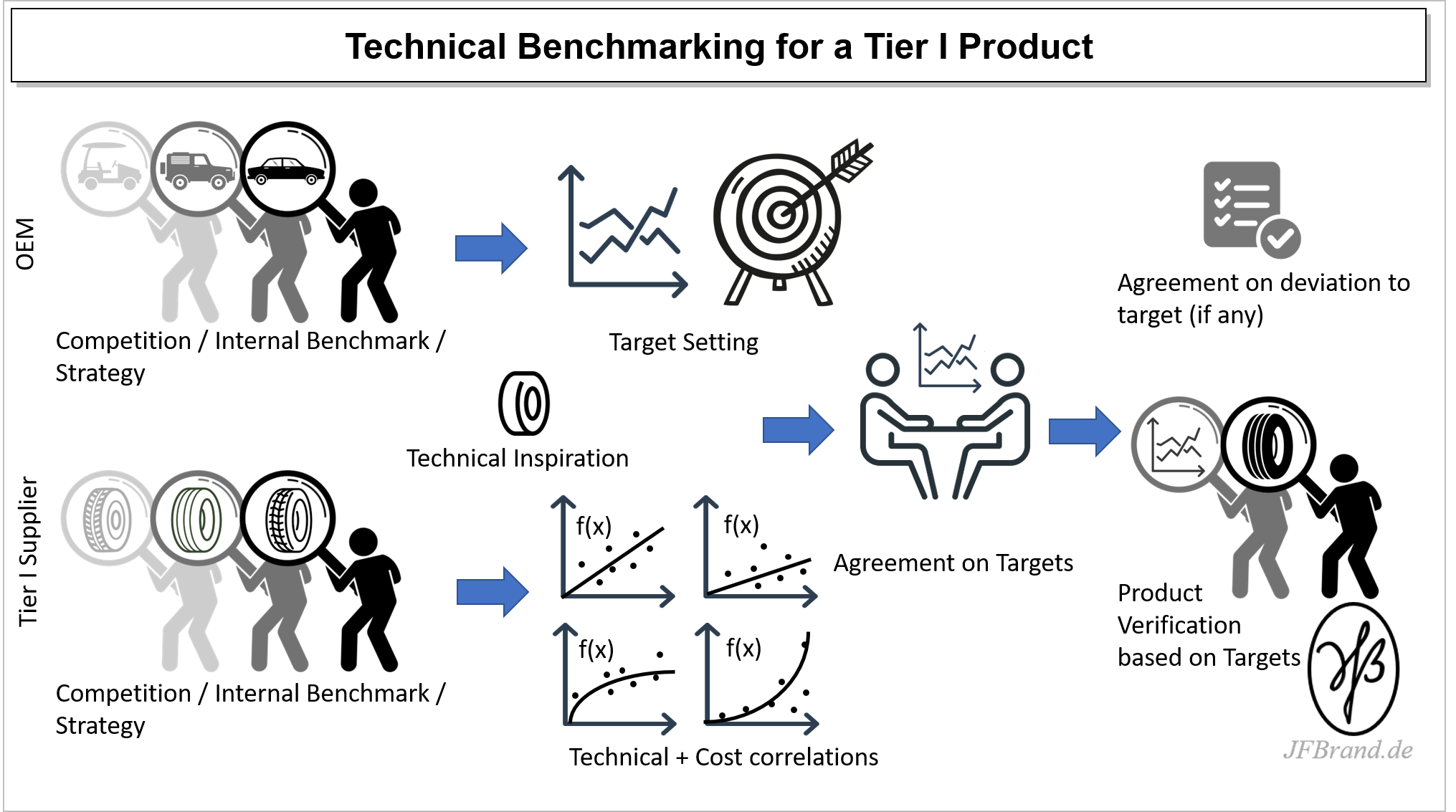
Back Principle of a Product Benchmark within Automotive
The Power of internal Product Benchmarking
Detecting correlations amongst technical variables, as well as between technical variables and costs,
gives a deeper understanding of a product and leads to a design, which is closer to satisfying the needs of the customer.
Product Benchmark, in the classical interpretation, is the practice of comparing current or future products to a reference,
which is the best in class in terms of cost, quality or innovation.
The biggest challenge for a classical Product Benchmarking is that the technical (functional, quality, manufacturing) and
cost properties are not easily accessible. The reliability of the data is then dependent on the effort taken for reverse engineering
of the benchmarked product. It would mean to perform:
geometrical measurements of a product, including tolerances
simulations
testing
manufacturing trials
quality analysis
cost calculations
Due to time and resource limitations, a Product Benchmark of a competitor product will focus on data, which is easier to acquire or is necessary for future product improvements.
This reduction of the data might disable:
the detection of impact factors on a technical property
the analysis of a correlation between the factors
Therefore, it is recommended to perform, in parallel, a benchmark of your own products, where you have the technical documentation available. It will enable the forecasting of any technical and cost boundaries of a product and give higher planning security within a development.